We are delighted to bring Pratibha Arts’ Paratopias to River Run Centre for the Guelph Dance Festival! This presentation feels extra special, as we were able to offer commissioning support, alongside Neighbourhood Dance Works (NL), to bring this production to life. Bageshree Vaze, an exceptionally talented artist who is the choreographer, composer and performing in Paratopias, provides some insight into the inspiration for this multi-disciplinary ensemble production and how it came to be after many years.
What motivated the creation of the work you are presenting at the Guelph Dance Festival?
As an Indo-Canadian artist, my work explores straddling my different worlds of India and Canada, and how that translates to dance.
I was born in India but moved to St. John’s, NL with my parents when I was 1 year old. I was introduced to Indian classical dance at the local Hindu Temple in the 1980s when the community hosted Toronto-based Bharatha Natyam artist Menaka Thakkar to teach during Easter and summer breaks. I discovered a rich, magical heritage in an unlikely environment, but dance and music had already been in my family: my mother Pratibha had performed Indian dance while growing up in Uganda, and my father, Dr. Damodar Vaze had trained in North Indian classical vocal music. I became fascinated by the limitless spectrum of Indian dance and music; I began my training in Indian classical vocal music with my father and went on to study with some of the greatest masters of classical dance and music in India. I have had the privilege of working with a wealth of music and dance artists in Canada and my aim is for South Asian-based arts to be a reflection and representation of Canadian cultural history.
In 2013 I came across the concept of ‘paratopia’ in an academic journal on dance. I had been exploring how to transcend notions of tradition and contemporary in my choreography and I read a piece by dance scholar Anurima Banerjee in which she talked about how Indian classical dance had manifested itself as a ‘paratopia,’ an alternate reality of performance. Indian classical dances originated in the temples and royal courts and had not been created for the modern, proscenium stage but have now created their own spaces of resistance against a colonial history. This got me thinking about how the same has happened in my own history of learning dance at the St. John’s temple, and as I continue to navigate the Canadian dance landscape. I was commissioned by DanceWorks in 2015 to create a Kathak dance-based work, and I had decided to explore this idea by creating a piece with Kathak beat language (which is based on the Tabla drums), but in conversation with non-Kathak bodies. This piece featured my longtime Tabla collaborator Vineet Vyas, a Human Beatbox artist Killabeatz and dance artists Daniel Gomez, Danny McArthur and Samantha Schleese. The piece captured the multicultural heart of what it can mean to be Canadian and explored intersections between Kathak and urban dance language. I was thrilled with the response to this 20-minute work and envisioned expanding the idea and methodology to create a full-length piece with particular reference to the history of the St. John’s Temple, the alternate reality our community created against a dominant colonial culture.
When did you start creating this work? And how has it evolved since its inception?
After remounting ‘Paratopia’ at the Canada Dance Festival in 2016, I started envisioning a longer work. In 2019, Neighbourhood Dance Works in St. John’s had produced a work ‘Navigating Home’ that brought together 21 artists originally from NL to explore their connection to the province and how this had manifested itself through their dance practice. All 21 artists were white, and it excluded any language other than Eurocentric, contemporary dance. I realized I had been naïve in assuming my existence as a NL-bred artist and my practice, and any culturally-diverse dance, whether it be racialized or Indigenous, were considered part of the Canadian dance fabric. We continue to exist as ‘other’ dance forms and people on the periphery. I decided to highlight this erasure and how we all create alternate realities to address colonial erasure in the full-length ‘Paratopias’ piece.
Since 2021, the piece has evolved in its Kathak language content, through the collaboration with a few extremely-talented Kathak artists who have been working with my company since 2023. Also, during the pandemic, Vineet Vyas and I spent a couple of weeks in a dance residency at the Banff Centre where we imagined new Tabla beat language. I’ve also been lucky to work with Bill Brennan, one of the most celebrated musicians from NL, and Sebastian Hirtenstein, a contemporary dance artist.
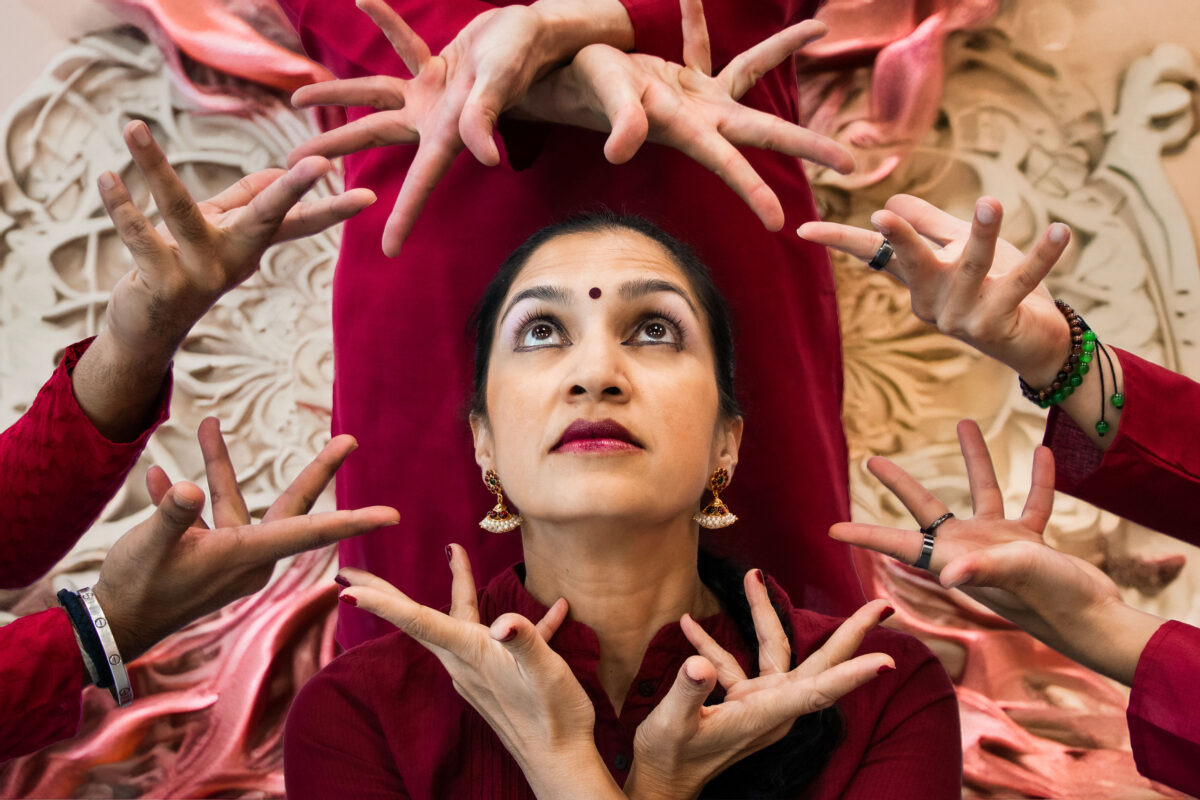
‘Paratopias’ has a narrative arc/content to feature the faces of the Indian community in St. John’s and the history of the Indian dance school, using video narrative and animation by talented visual artist Mathew Jacob. Mathew used for inspiration the aesthetic of ‘Amar Chitra Katha’ comic books on Indian mythological stories which I read as a child growing up in NL. ‘Paratopias’ also combines a few different Indian dance languages, in particular Bharatha Natyam aesthetics (hand gestures or mudras), since this was and is still the dance form taught at the St. John’s Hindu Temple. I’ve worked with Hirtenstein and Gomez on exploring more intersections between our dance languages and this has evolved over the past couple of years.
What role has collaboration played in the creation and performance of Paratopias?
With all choreography and creation, you start with an idea but how it manifests itself in the studio and eventually the stage is a result of collaboration with the bodies and minds with whom you choose to work – I’ve been extremely lucky to have all these artists in my orbit to enrich and enhance my ideas as I’ve detailed above.
Is there anything you hope the audience will take away from the performance in Guelph?
If the audience has never experienced Indian classical dance languages, I hope they will see they are just as contemporary as any other and just as much a part of Canadian history as any other. It is my great privilege to come from a civilization that has produced the most brilliant and complex dance forms of Kathak, Bharatha Natyam, Odissi, and Kuchipudi among others, but they are just as much Canadian as any European-based dance form. Newfoundland culture, or any culture, is not just one thing and can be at its very best by drawing on this diversity.
We live in an age of Truth and Reconciliation, and I don’t take for granted one single moment how lucky I am to celebrate my ancestral culture on the same land that has seen Indigenous cultures and languages erased. ‘Paratopias’ references how non-white cultures create their own spaces aware of the violence and history of Europeans in North America. Indian dance has had its own history of colonial oppression, and I experienced this erasure with the ‘Navigating Home’ project, and now we continue to live in a political environment of growing racial divisions and anti-immigrant sentiments all over the world. The message of ‘Paratopias’ is we all come from the same place of human existence, but we create our own spaces and become who we are when we choose to resist domination. It’s naïve to think we can all live in harmony, but the best way to navigate this reality is to create our own alternate vision through dance and music.
Join us for this exciting production on Saturday June 6th at 8:00 PM at River Run Centre! Tickets are on sale now! Be sure to also check out the rest of the festival weekend programming!